Voices in the Void or Builders of Power

By Ranveer Singh | @ranveer5ingh
12 min read.
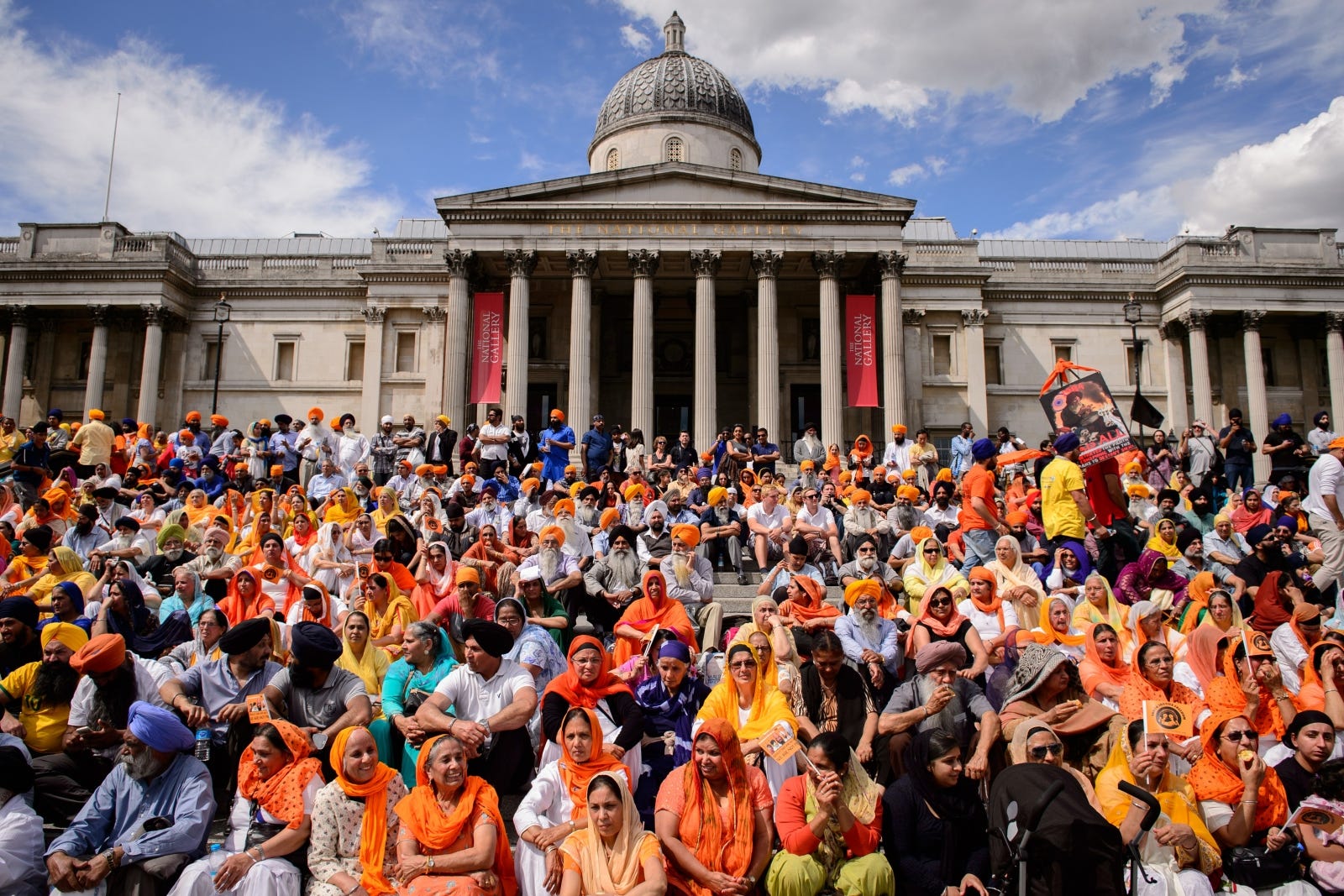
I went to my first protest in 2011, when Sikhs were gathering in Trafalgar Square, London, to mark twenty-seven years since the Indian government’s military attack on Sri Darbar Sahib, the Golden Temple. I was young, enthusiastic and eager to make my voice heard. I remember jumping on a coach from Southall which drove down the A4 past Knightsbridge into Hyde Park, but I don’t remember much from the day, other than it was warm, colourful, loud and a little underwhelming.
Throughout history, there have been countless moments when individuals united by principle and outrage have risen to speak up. But what do they truly achieve in the end? Do they reshape the world, or do they merely cry into the wind?
When we analyse peaceful protests calling for change, we see they are often met unfavourably by entrenched power. From the March on Washington in 1963 to Tiananmen Square in 1989, the anti-Iraq War protests in 2003, and more recently the Free Palestine marches, every generation has raised its voice. And yet, the world remains largely unchanged. Its structures, governments, corporate interests, and geopolitical underpinnings remain stubbornly intact. Sikhs who have attended the June Rally over the years will know this first-hand, as pleas for truth, justice and freedom continue.
When we look beyond the surface, from the vantage of real power, this form of protest is manageable and predictable, and governments have perfected the art of containment. Most of the time, these gatherings are ignored entirely, with little to no response or recognition. The 2003 Iraq War protests made this brutally clear. One of the largest coordinated demonstrations in human history, spanning over six hundred cities and involving millions of people, failed to prevent invasion. The message was loud, but power had already turned its head. And for us, in the 41 years of assembling at Hyde Park, there has been no meaningful response.
On the contrary, India has been allowed to carry out a genocide across Panjab, and in more recent years assassinated Sikh activists on foreign soil. Despite promises from the blue and red party, Jaggi too remains locked up in an Indian prison cell. Sikh activists in the UK have been targeted, profiled and had their movement restricted. This has all occurred against the backdrop of 1984, and irrespective of whether it is the blue, red, green or yellow party, it proves that promises will remain undelivered because the demands do not align with UK foreign policy.
When I think back to that day in 2011, that feeling of being underwhelmed perhaps stemmed from a kind of naivety, an expectation that something would shift. And when it did not, I was left anticipating the next gathering. And the next. Yet, when I reflect now, there is irony in the image of Sikhs gathered outside landmark sites like Trafalgar Square or in front of parliament buildings and embassies. These are not just public spaces, they are symbols of enduring authority. To march, chant or wave placards outside them is to acknowledge their primacy. It affirms, albeit inadvertently, the primacy of those very institutions.
This is not reflective of historic Sikh mobilisation. To echo the sentiments of Sant Jarnail Singh, can we imagine a world in which Sukha Singh and Mehtab Singh plead in front of the Mughal regime to remove Massa Rangar? Or an instance of Banda Singh Bahadur petitioning Bahadur Shah?
No, that is unfathomable. Yet we persevere with the protests, fourteen thousand, nine-hundred and sixty five days, and counting.
So, are these modern-day protests worthless? Not entirely. There is value in memory and morality. Protests create a public record. They show what people stood against and they draw moral lines. In a world driven by egos and self-interest, protests remind us that some consciously choose to stand on the right side of history; that some will not go quietly, even if it costs them everything.
But often, that is where the value ends.
The uncomfortable truth remains that civil disobedience and protest actions, such as the annual June Rally, are ineffective in the wider Panthic goal of removing the structures that uphold oppression. They may honour the pain, but do little to dismantle the systems that produced it. This is not a critique of the organisations that work tirelessly to hold the event, it is a deeper assessment of protests. Ultimately they do not alter the dynamics of power, and whilst the organisers may be cognisant of this, the average protestor is not, and in some instances may assume that only the British government can deliver justice.
In the aftermath of 1849, Sikhs were not permitted to govern, only to remember, and even that, selectively. Sikh political existence was substituted with religious existence, and any expression of sovereignty was violently opposed. Over the course of the 20th century, Sikh mobilisation soon morphed into activism, and as Sikhs entered foreign lands, this activism soon became reactionary. The muscle memory of sovereignty slowly atrophied. In its place, a pattern emerged within the limits of civil disobedience: shout, rally, burn out, repeat.
For the post-1984 generation, especially within the diaspora, this has become a legacy. Our organisations were born out of urgency and grief, not long-term planning. They emerged because they had to. But urgency alone does not guarantee fulfilling the objective of Khalistan, just like passionate speeches do not affect UK foreign policy.
That being said, there is a certain beauty in seeing Sikhs gather in unity. It is heartfelt. It is defiant. Protests are something I understand if not value. Crucially, amongst it all there is a question: are we only building like exiles? Temporary, uncertain, always responding? Without structures designed to last, can anything more than symbolic resistance truly emerge?
Perhaps we need to begin thinking not only of what we protest against, but what we are willing to build. Not in the shadows of empire but on our own terms. In any event, we must adapt and move beyond this insistence on “raising awareness” or this self-imposed responsibility to educate the world about our struggle, because the reality is, the world doesn’t care.
When the world doesn’t care, the real challenge becomes glaringly obvious; shifting from speaking against power, towards reimagining how to wield it.
So, you may be wondering, how do we move beyond the protest itself? How can these gatherings, powerful as they are for some, be strengthened to create lasting change?
We must expand our toolkit.
Firstly, community institution building is crucial. True power thrives within the institutions that educate, nurture, and organise. Within the Sikh diaspora, building centres for education, culture, and support within existing Gurdwara spaces has the potential to create a backbone of resilience. Classes that teach our history, centres that foster dialogue and solidarity, media platforms that tell our stories unapologetically and loudly, all these help to maintain identity and political will beyond fleeting moments of protest.
Secondly, strategic alliances hold immense potential because our struggle doesn’t exist in isolation. The fight against injustice and colonial legacy overlaps with many others, and social media has made those intersections more visible than ever. Collaborating with aligned movements amplifies both voice and impact.
Owning the narrative is also key. In an age dominated by digital media and rapid information flow, storytelling is a form of power. Through books, art, film, social media and independent journalism, we can challenge dominant narratives that erase or distort our struggle. Reclaiming our voice disrupts the silence that governments rely on to maintain the status quo. It forces recognition, sparks conversations and builds empathy in ways that placards alone cannot.
But we do not need to reinvent the wheel. We don’t need another new organisation, or a complete overhaul. We need to recalibrate and realign under one objective. This involves collaboration between key players, committed to training and capacity building within the Panth. Political education, leadership development and strategic planning to prepare us for the long haul. We must equip ourselves not only to protest but to organise and build agency. The muscle memory of sovereignty, once strong and purposeful, can be reawakened with deliberate nurturing. Passing this knowledge to the next generation ensures continuity and growth beyond reactive cycles.
None of this means that we must necessarily abandon protests or raise fewer voices in public. Far from it. Like I said above, protests remain important vehicles for memory, morality and defiance. But to truly reimagine power, to shift the relentless gears of empire and oppression, requires visible resistance in the streets that is matched by invisible infrastructure within our communities.
I’m reminded of my MA reading of Hannah Arendt, who argues that power is not something owned by governments or individuals, it is something that exists only when people act together. She writes, “Power springs up whenever people get together and act in concert.” When communities organise, build institutions, and maintain sustained action, power becomes something real, not just a cry into the void, but a presence that must be reckoned with.
If we can combine the passion of protests with the strength of institutions, alliances, narratives and leadership, we move closer to wielding power on our own terms. We honour the legacy of those who fought before us, not only by remembering their sacrifices, but by creating structures that endure and transform.
Yet an uncomfortable question remains, so let me briefly address it now. It underpins the entire arc of this article and my suggestions above; what is the purpose of building institutions, narratives and alliances in the diaspora when the injustice itself is taking place in Panjab, under the jurisdiction and control of the Indian state? This is not a rhetorical question, it is the existential dilemma of the diasporic movement.
The Indian state is not simply a violator of rights. It is a sovereign entity with geopolitical power, economic clout and as we all know, the ability to violently assert its policies. Nothing that is built in Southall, Smethwick or Slough is binding upon it. No community school or awareness campaign in the UK can force the hand of Delhi. That is the paradox at the heart of this work; all our energy and strategy is being developed in a place that cannot deliver what we ultimately seek.
We can protest, organise and educate, but we cannot enforce. Some Sikhs in the UK may still act as though Westminster is an arbiter of justice, but, as we have seen British foreign policy is transactional, not ethical. Jaggi’s case and the silence over transnational repression prove this. The diaspora may believe it is lobbying a democratic ally, but in reality, it is speaking into an echo chamber that is unmoved by moral appeals.
This is the diaspora’s dilemma, that we must contend with.
We live in nations that trade with India, arm it, legitimise it. Our demands are seen as a commotion, not an obligation. And yet we cannot stop. To do nothing is to betray the struggle, history to be rewritten, and our people to suffer in silence. This is why many of the suggestions in this piece, from institution building to owning narrative, are not offered as magical solutions, but as ways to preserve agency in a landscape where direct action is limited. That may not be a glamourous or satisfying perspective, but it may be the only viable one.
In this light, the work of the diaspora must be seen not as the solution, but as preparation, and as supplementary to the work on the ground in Panjab. That is ultimately where it matters. Our work here is not binding on the political realities in Panjab, but our work here preserves a Panthic consciousness beyond India’s borders, it safeguards memory from erasure, and ensures that when political conditions do shift, and history shows they eventually do, the Sikh Panth is prepared.